


You may also like
-

Tonga-Tabou Poster
J. Tastu · 1833 · Tonga-Tabou becomes a precise scientific print for nautical wall art
Poster from €9 · Framed from €16
-

Pirogues of Batavia Poster
J. Tastu · 1833 · Scientific print of Batavia pirogues with sailboat studies and muted maritime tones
Poster from €9 · Framed from €16
-

Chinese and Javanese boat Poster
J. Tastu · 1833 · Chinese and Javanese boat scientific print in muted grey and blue
Poster from €9 · Framed from €16
-

Celebes Canoe Poster
J. Tastu · 1833 · Scientific print of Celebes canoe plans in fine black linework
Poster from €9 · Framed from €16


-

"Very nice Posters. The quality is amazing and we received it very quickly !"
-

"A shop to visit absolutely. Huge selection of posters. We spent more than an hour there !"
-

"Perfect to find gift. Price are very good. An they can frame and pack it on site"
About the Artist
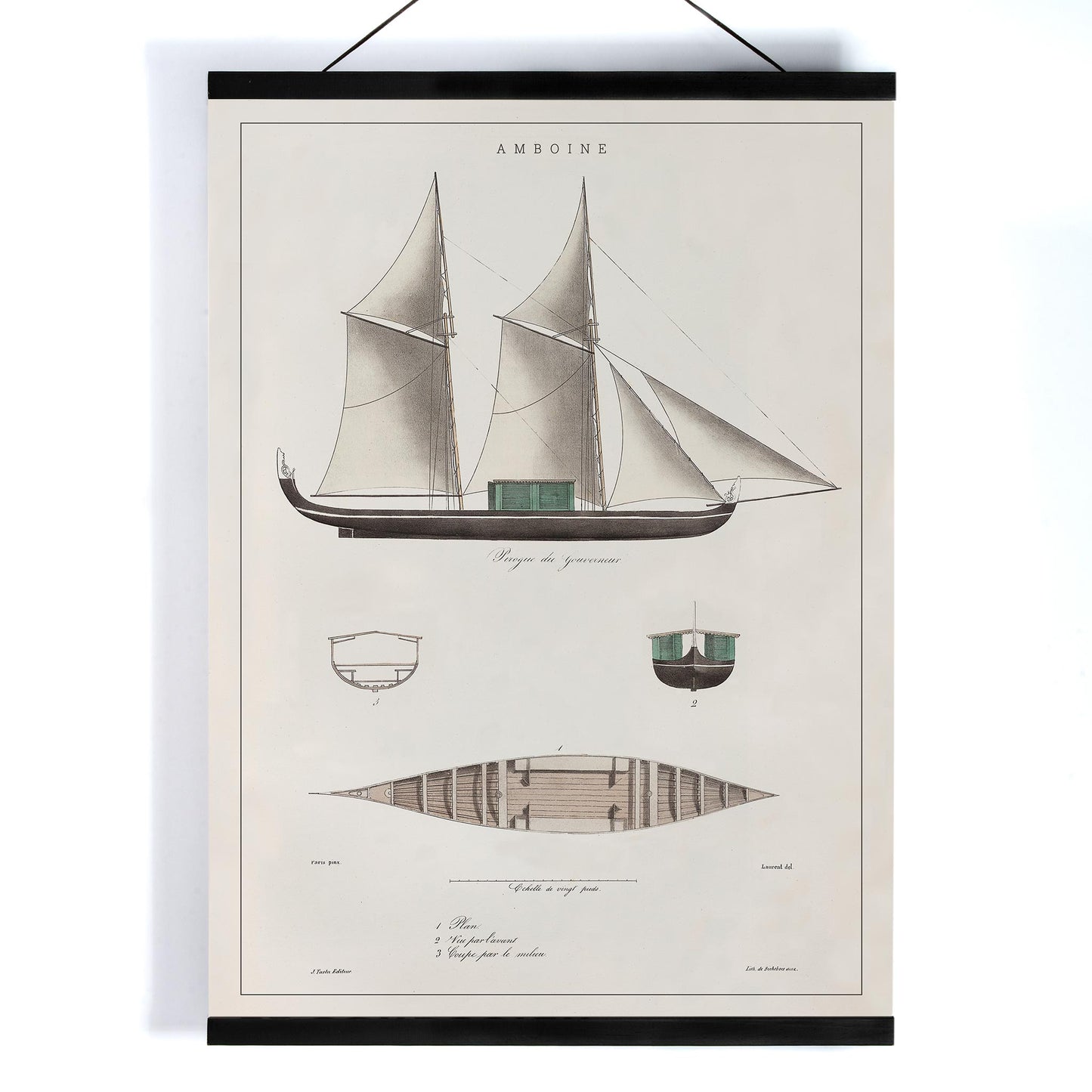
J. Tastu appears here as the hand behind a precise 1833 maritime print, a work that links Paris publishing with the growing appetite for voyage accounts and scientific illustration. In Amboine, the artist’s role is tied to clarity rather than spectacle: the sheet turns a sailing vessel into collectible knowledge, the kind of vintage poster image that could travel from an archive into a home as refined wall art.
The Artwork
Amboine refers to Ambon, the island port in the eastern archipelago that belonged to the world of spice routes and naval travel. This fine art print was made for readers who followed distant coasts through books, where a ship study could stand in for exploration itself. The poster captures that nineteenth century curiosity about mapping, measuring, and recording the sea, and it does so with the discipline of a scientific print meant to inform as much as to please.
Style & Characteristics
The image is spare and tall, with a pale beige field that lets the ship read almost like a specimen on paper. Soft grey sails, black hull lines, and the small green cabin block give the vertical poster its restrained palette. Below the main vessel, the smaller technical views and measured diagrams add a quiet sense of examination, while the thin lettering keeps the composition airy. As vintage print wall art, it relies on precision, open space, and the contrast between the large ship form and the smaller working details beneath it.
In Interior Design
Above a walnut desk in a study, this art print would bring a calm maritime note to a room shaped by books and daylight. Its vertical format suits a narrow wall, where the pale paper can sit comfortably beside natural wood and dark metal without crowding the space. The sailing ship and technical drawings give home decor a thoughtful, archival feel, making interior decoration look informed rather than themed. In that setting, the poster adds a measured presence that suits a collector who values sea and ocean subjects with scientific character.