




-

"Very nice Posters. The quality is amazing and we received it very quickly !"
-

"A shop to visit absolutely. Huge selection of posters. We spent more than an hour there !"
-

"Perfect to find gift. Price are very good. An they can frame and pack it on site"
About the Artist
Behind this mountain lies a patient act of reading. Giuseppe Campi was a Dante scholar and commentator; his name connects this 1891 print to the study of the Divine Comedy rather than identifying the engraver. That distinction matters when approaching a Giuseppe Campi art print: the attribution points toward the interpretation of a poem whose imagined geography demands close attention. Il Purgatorio makes that scholarly encounter accessible beyond the page. Looking at this vintage print, a reader can trace the relationship between a literary journey and the moral order that gives it meaning.
The Artwork
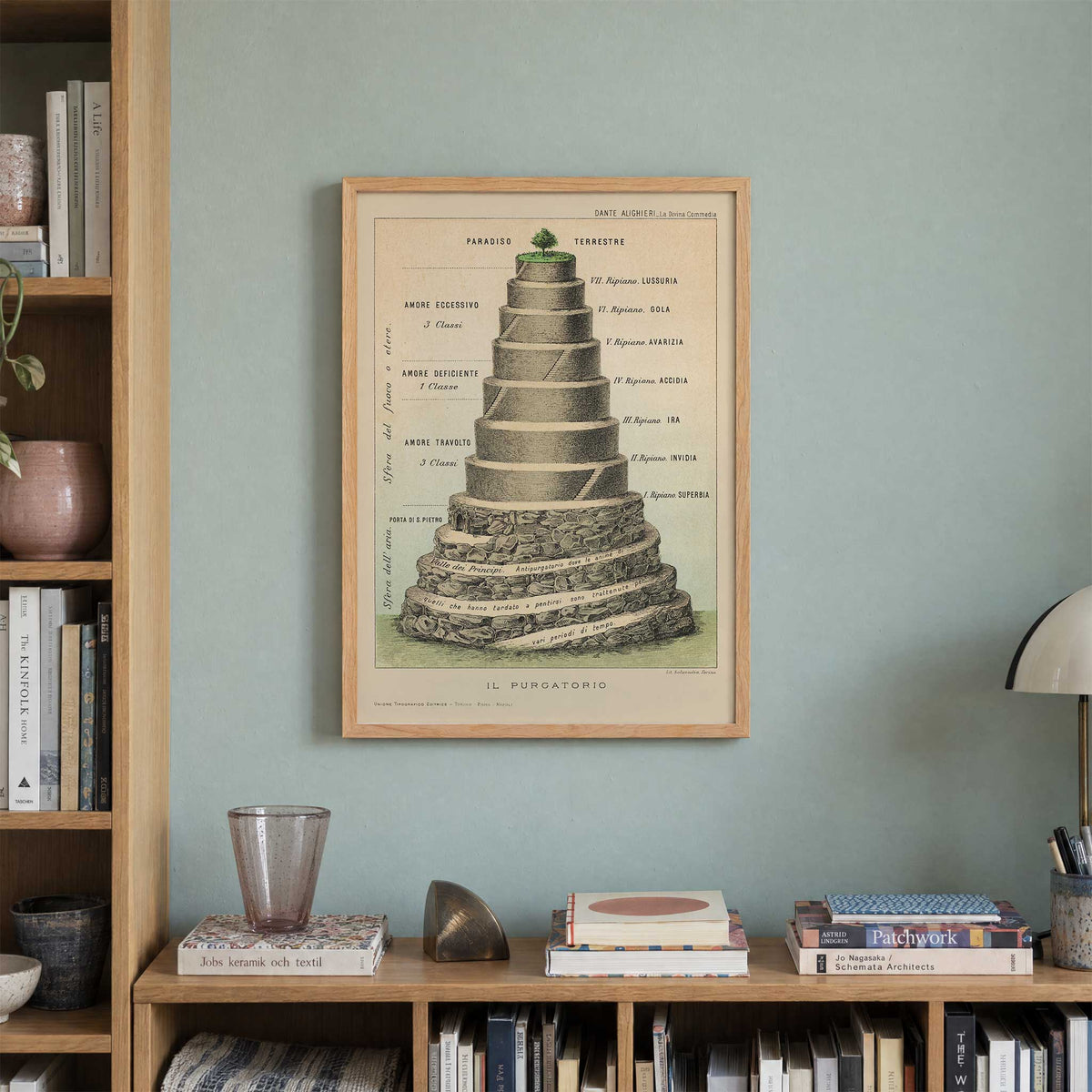
The journey does not end when Dante leaves Hell. Il Purgatorio concerns the next stage of the Divine Comedy, where souls undergo purification before entering Paradise. Unlike the punishments of the Inferno, this ascent holds out the possibility of change. Seven terraces correspond to the seven deadly sins, while the Earthly Paradise marks the completion of this stage. The diagram translates that demanding literary itinerary into a reference readers can consult alongside the poem. For someone exploring Dante Alighieri through a vintage poster, Purgatory becomes a place where spiritual progress can be understood as a journey.
Style & Characteristics
A small green tree rises above the highest terrace, far from the broken rocks below. The eye climbs toward it along slanting paths that cross the broad, shadowed tiers. Dense hatching roughens the lower slopes; higher up, the mountain appears smoother and more tightly contained. Warm beige surrounds the ascent, while muted green spreads around the foot. Fine Italian typography runs beside the terraces, rewarding a closer look at this nineteenth-century literary map print. Beneath the mountain, the widely spaced letters of IL PURGATORIO draw the gaze back down to the pale lower margin.
In Interior Design
Imagine a reading corner in late afternoon, where light crosses an oak desk and reaches the pale ground of this vertical poster. Hung above a low shelf of well-used books, the Purgatory fine art print invites a pause between pages to follow the mountain upward. A narrow dark frame echoes the ink without competing with the delicate lettering. For home decor centred on reading, the subject gives the wall art a direct relationship to the activity below it. Keep the surrounding interior decoration restrained so the small terrace labels remain something to approach and study.